Public perspectives: exploring the use of Large Language Models for de-identifying free-text
02/07/2026
Our STAR-TRE project aims to develop a toolkit to support secure research access to de-identified free-text data through Trusted Research Environments. As a critical foundation of this project, Ipsos have delivered a comprehensive report detailing public views on the possible use of Large Language Models (LLMs) to identify privacy risks in free-text.
During the workshops, participants discussed how LLMs could quickly identify privacy risks, making data available for research more swiftly. However, they also raised concerns around LLM accuracy and the balance between minimising privacy risks and the value of data made available for research.
Benefits and challenges
Our STAR-TRE project is focussed on free-text administrative data. These data contain rich contextual information that can help researchers understand complex situations and outcomes. However, free-text data are rarely shared for research due to the unpredictable presence of indirect identifiers, such as recognisable locations or social circumstances. When indirect identifiers appear individually, the possible privacy risk is relatively small, but when combined they pose a more significant privacy risk.
Technology, such as Large Language Models, could help assess privacy risks in free-text extracts by detecting potential identifiers such as ages, dates, specific locations, sensitive conditions, and so on. However, since LLMs are relatively new, we wanted to understand public opinions on their possible use.
The process
We used a deliberative approach due to the complexity of the topic: participants learnt about key concepts ahead of discussing important questions and forming recommendations. For STAR-TRE, nearly 40 participants attended an online introductory workshop to learn and explore key topics such as Trusted Research Environments, de-identification, Large Language Models, and privacy risks in free-text data.
Over the following fortnight, participants attended one of four workshops held in each nation of the UK. In these events, participants collaborated to de-identify fictional free-text data extracts and then compared their results with those produced by an example LLM.
Based on this experience, participants debated the benefits and concerns of using LLMs and then defined measures to ensure their safe and trustworthy use.
“When I read reports, when any human does, we read what we think we’ve written, not what we’ve actually written… [we can miss that] there are words missing, sentences that don’t make sense... [an LLM] will never do that.”
(Participant, Cardiff workshop)
Key recommendations
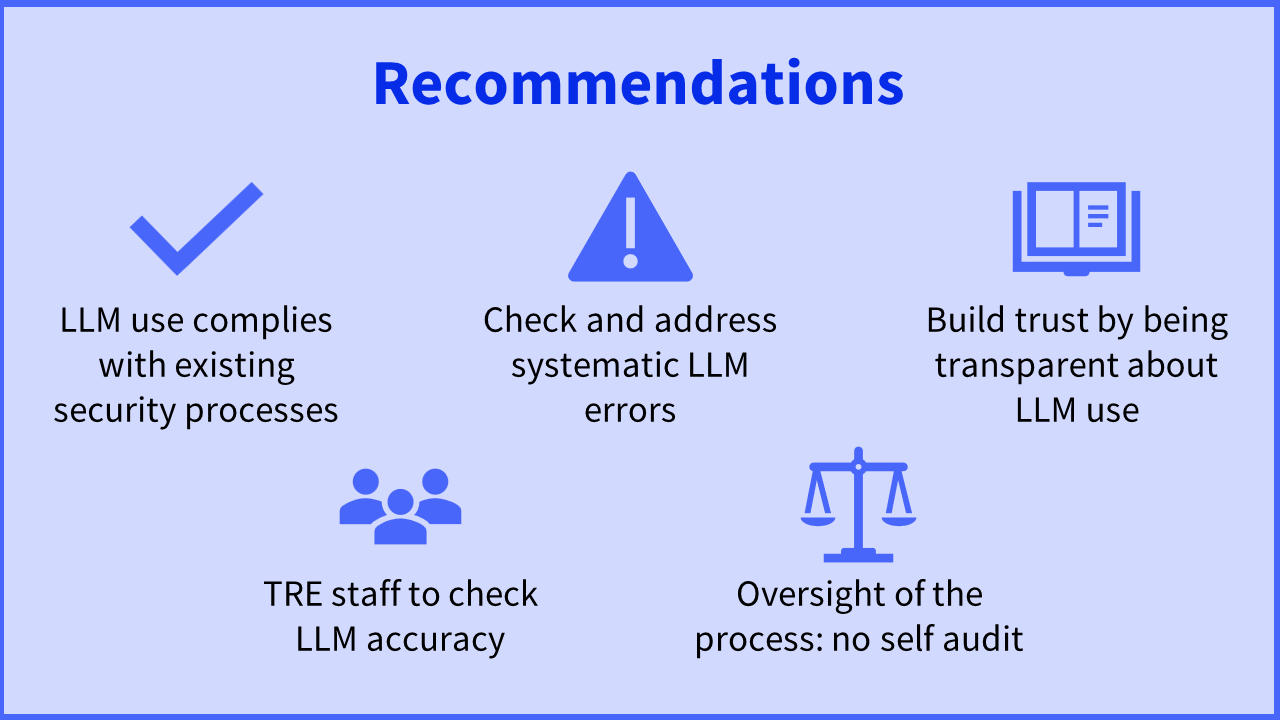
The five recommendations on the use of Large Language Models to help de-identify free-text developed through by participants in the STAR-TRE public workshops.
Participants produced the following key recommendations for the safe and trustworthy use of LLMs:
1. Ensure that the use of LLMs complies with existing data-security processes in Trusted Research Environments.
2. Keep human involvement in the process to check the quality of LLM outputs and build trust and confidence in the results.
3. Include an ethics review of the process and LLM outputs, particularly focussing on possible bias and errors.
4. Ensure there is oversight of the process and penalties for data misuse.
5. Be transparent about how LLMs are used in de-identifying data.
Beyond these recommendations, the conversations across all the deliberative workshops helped us to understand the core concerns and – more positively – the hopes that participants had for our overall ambition.
“We put down speed [of the LLM] as a benefit, because for the LLM to basically identify what text needs to be taken out, [it] can do it in 10 seconds. It will take us [humans] a lot more time than that.”
(Participant, London workshop)
Next steps
We’re taking the recommendations from these workshops into the development of a privacy risk toolkit focused on free-text.
Ultimately, we are looking to create the blueprint so that Trusted Research Environments across the country have the practical tools to de-identify free-text more robustly, yet efficiently. This will provide the foundation for valuable free-text to become a more regular feature of research involving routine data while still keeping privacy protected.
Acknowledgement
Funded by DARE UK [grant number: UKRI3005], the STAR-TRE (Safe and Trustworthy Assessment of Risk in Trusted Research Environments for Sensitive Free-Text De-Identification) project is led by DataLoch at the University of Edinburgh working in collaboration with the Scottish Safe Haven Network and University of Sussex.
Dr Arlene Casey holds a Vivensa Senior Research Fellowship [grant number: PF2302/2].
Other Interesting Articles
COVID-19 Collaborative02/09/2021
In light of the COVID-19 crisis, in March 2020 colleagues from NHS Lothian and the University of Edinburgh asked the DataLoch team to help in the production of a dedicated COVID-19-linked dataset. This request was motivated by a need to support immediate hospital-based service management and to provide a foundation for active and anticipated regional and national research into the outbreak.
In light of the COVID-19 crisis, in March 2020 colleagues from NHS Lothian and the University of Edinburgh asked the DataLoch team to help in the production of a dedicated COVID-19-linked dataset. This request was motivated by a need to support immediate hospital-based service management and to provide a foundation for active and anticipated regional and national research into the outbreak.
DataLoch joins the UK Health Data Research Alliance11/11/2021
On 20 October 2021, DataLoch became one of the newest members of the UK Health Data Research Alliance (“the Alliance”). Member organisations work together to develop and coordinate the adoption of standards, tools and technologies for the secure and trustworthy use of data in health research.
DataLoch joins the UK Health Data Research Alliance11/11/2021
On 20 October 2021, DataLoch became one of the newest members of the UK Health Data Research Alliance (“the Alliance”). Member organisations work together to develop and coordinate the adoption of standards, tools and technologies for the secure and trustworthy use of data in health research.